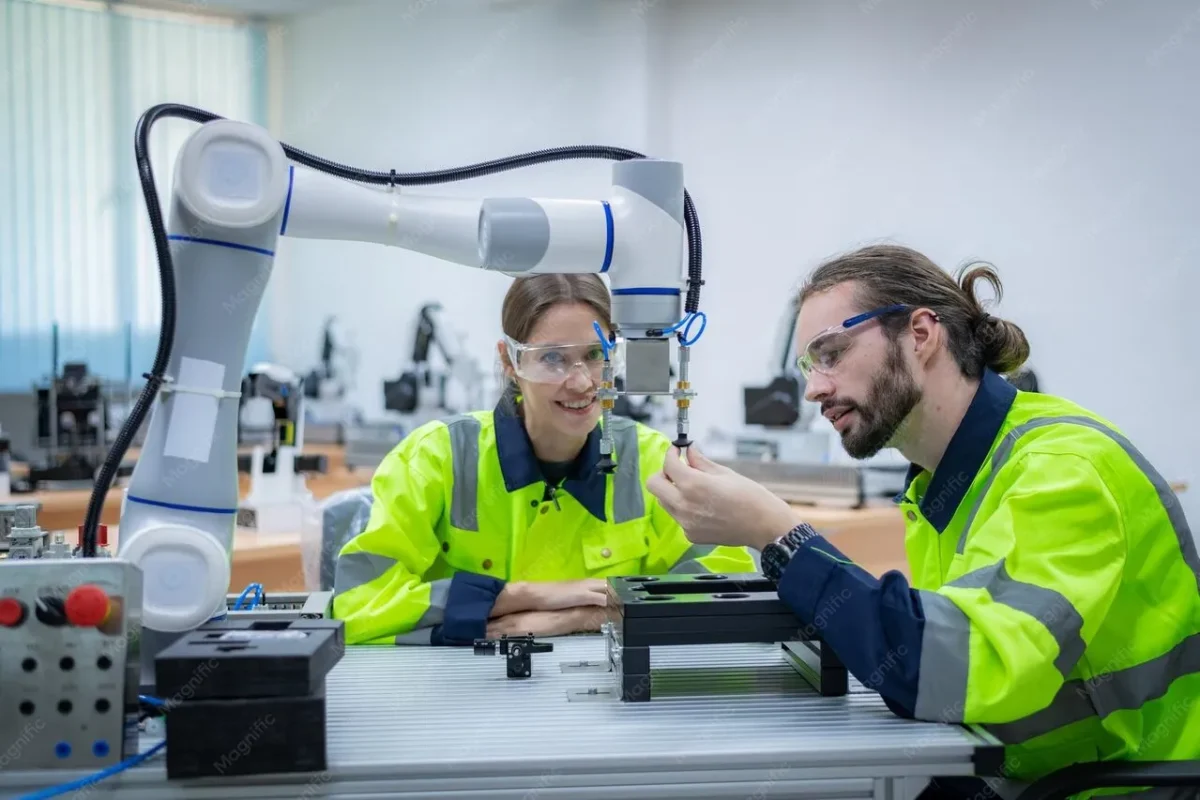
Cobots and industrial robots are both used to automate manufacturing tasks, but they are designed for different operating environments and production requirements. Cobots are generally built to work alongside people, while traditional industrial robots are commonly deployed for high-speed, repetitive, and physically demanding processes within controlled workspaces.
The right choice depends on factors such as production volume, task complexity, workspace, payload, safety requirements, and the level of automation required. Understanding these differences helps manufacturers select an automation approach that fits their existing workflows.
What Is a Cobot?
A collaborative robot, commonly called a cobot, is a robotic system designed to operate in proximity to human workers for suitable applications. Cobots are typically used for repetitive or ergonomically demanding tasks where human workers and robotic equipment can share parts of the same workflow.
Common cobot applications include:
- Machine tending
- Pick-and-place operations
- Assembly
- Packaging
- Inspection
- Material handling
- Palletising
Cobots are often easier to redeploy between tasks than some traditional robotic installations. However, collaborative operation does not mean that every cobot can work safely with people under all conditions. A proper risk assessment, application-specific safeguards, and compliance with relevant safety requirements are still necessary.
What Is an Industrial Robot?
An industrial robot is an automatically controlled, programmable machine designed to perform manufacturing tasks with speed, precision, and repeatability. Industrial robots are commonly installed in dedicated work cells where access is controlled using safeguards such as fencing, interlocks, scanners, or other protective systems.
Industrial robots are widely used for:
- Welding
- Painting
- High-speed material handling
- Palletising
- Machine tending
- Assembly
- Packaging
- Component handling
Traditional industrial robots can handle higher payloads and faster repetitive movements in many applications. Their suitability makes them particularly valuable for high-volume manufacturing environments where consistent cycle times are important.
What Is the Difference Between Cobots and Industrial Robots?
The main difference between cobots and industrial robots is their intended operating environment, application requirements, and performance characteristics. Cobots are designed for collaborative applications under defined conditions, while industrial robots are often designed for higher-speed or higher-payload automation within safeguarded workspaces.
| Factor | Cobots | Industrial Robots |
| Human interaction | Designed for suitable collaborative applications | Usually operate in safeguarded workspaces |
| Payload | Generally lower | Available across a wider range, including high payloads |
| Speed | Often suited to moderate-speed applications | Suitable for high-speed production |
| Flexibility | Often easy to redeploy | Usually integrated into dedicated cells |
| Installation | Can be relatively compact | May require larger dedicated workspaces |
| Safety | Application-specific risk assessment required | Safeguarding is commonly required |
| Production volume | Suitable for low to medium-volume applications | Well suited to high-volume production |
| Programming | Often designed for accessible programming | Can require specialised programming and integration |
| Typical use | Assembly, tending, inspection, packaging | Welding, painting, high-speed handling, heavy-duty tasks |
These are general characteristics rather than absolute rules. Robot capabilities vary significantly between manufacturers and models.
When Should Manufacturers Choose Cobots?
Cobots can be appropriate when manufacturers need flexible automation for repetitive tasks and want the robotic system to operate close to workers under suitable safety conditions. They can be particularly useful where production volumes or product variations make fixed automation less practical.
Cobots may be considered when:
- Production involves frequent product changes
- Floor space is limited
- Tasks are repetitive but do not require very high speed
- Human workers need to remain involved in the process
- The automation needs to be redeployed between tasks
- Manufacturers are gradually introducing robotics
For example, a manufacturer producing several product variants may use a cobot for machine tending or assembly while workers handle inspection, setup, or other variable activities.
However, the application should always be evaluated through a proper safety assessment before collaborative operation is implemented.
When Are Industrial Robots a Better Choice?
Industrial robots are generally better suited to applications requiring high speed, high payload, precise repeatability, or continuous operation in a dedicated production cell. They are widely used when manufacturers need consistent automated performance at production scale.
Industrial robots may be preferred for:
- High-volume production
- Heavy material handling
- High-speed palletising
- Welding
- Painting
- Continuous repetitive operations
- Applications requiring larger payloads
- Processes requiring controlled robotic work cells
For instance, an automotive manufacturing line may use industrial robots for welding or material handling because these applications can require high speed, repeatability, and carefully controlled operating zones.
How Does Industrial Automation Software Support Robotic Systems?
Industrial Automation Software connects machines, control systems, data, and production workflows so manufacturers can monitor and coordinate automated processes. The software layer can help collect operational information and provide visibility into machine activity.
Depending on the implementation, automation software may work with:
- PLCs
- HMIs
- Robots
- Sensors
- Barcode scanners
- RFID devices
- Industrial networks
- Manufacturing systems
- Production databases
For example, a robotic machine-tending application may use sensors and controllers to determine whether a machine is ready for loading. The software can coordinate the relevant workflow and capture production information.
The objective is not simply to automate an individual machine. It is to connect automation with the wider manufacturing process.
How Does Industrial IoT Software Improve Robot and Machine Visibility?
Industrial IoT Software helps manufacturers collect and analyse data from connected machines, robots, sensors, and production equipment. This creates greater visibility into equipment performance and production conditions.
Data may include:
- Machine operating status
- Production counts
- Cycle times
- Downtime
- Alarm conditions
- Equipment utilisation
- Energy-related information
- Process parameters
For example, data from a robotic work cell can be combined with machine information to identify production interruptions or changes in cycle time.
This type of connectivity can support monitoring and analysis without requiring every decision to be made manually.
Can Cobots and Industrial Robots Be Used With the Same Manufacturing System?
Yes, cobots and industrial robots can operate within the same broader manufacturing environment when their control, communication, safety, and data requirements are properly integrated. The choice of robot does not have to determine the overall software architecture.
A connected manufacturing environment may include:
- Cobots
- Industrial robots
- CNC machines
- PLCs
- Sensors
- Vision systems
- Barcode or RFID devices
- Production software
- Industrial IoT platforms
A common software and data layer can help manufacturers monitor different types of equipment through a structured system.
This is where Manufacturing Automation Software can provide value by connecting individual automation systems with wider production workflows.
How Does Industry 4.0 Change the Role of Robots?
Industry 4.0 connects machines, software, sensors, and production data to create more connected and data-driven manufacturing environments. In this model, robots are not treated as isolated machines but as connected components of a wider production system.
Industry 4.0 initiatives may involve:
- Industrial IoT connectivity
- Machine data collection
- Real-time production monitoring
- Digital dashboards
- Predictive maintenance
- Automated traceability
- Production analytics
- Connected quality processes
For example, robot cycle-time information can be combined with machine and production data to provide a broader view of manufacturing performance.
Industry 4.0 Software can therefore help manufacturers move from standalone automation toward connected production environments where equipment data supports operational decisions.
What Factors Should Manufacturers Consider Before Choosing a Robot?
Manufacturers should evaluate the production task, payload, cycle time, workspace, safety requirements, product variation, and integration requirements before selecting between a cobot and an industrial robot.
Key questions include:
- What payload does the application require?
- What cycle time must the process achieve?
- How repetitive is the task?
- Does the application require human interaction?
- How much workspace is available?
- What safety measures are required?
- How frequently will products or processes change?
- What level of integration with existing machines is required?
- What data needs to be collected?
- Can the system scale as production requirements change?
The most suitable option is the one that meets the actual process requirements rather than simply being the newest or most flexible technology.
Can Software Make Cobots and Industrial Robots More Effective?
Software can improve the operational value of robotic automation by connecting robot activity with machines, sensors, production processes, and business data. This provides manufacturers with greater visibility and can support more structured automation workflows.
A connected automation environment can help businesses:
- Monitor machine activity
- Collect production data
- Track process events
- Connect equipment with workflows
- Identify downtime
- Improve traceability
- Analyse production performance
Industrial Automation Software provides the broader control and integration layer, while Industrial IoT Software can support data collection and connectivity across equipment.
Together, these technologies can form part of a wider digital manufacturing strategy.
Which Is Better: Cobots or Industrial Robots?
Neither cobots nor industrial robots are universally better; the appropriate choice depends on the manufacturing application. Cobots are often suitable for flexible, collaborative tasks, while industrial robots are commonly preferred for high-speed, high-payload, and dedicated automation applications.
A manufacturer should consider:
- Production volume
- Required cycle time
- Payload
- Product variation
- Available floor space
- Safety requirements
- Human involvement
- Integration requirements
- Future scalability
The decision should be based on the complete production workflow rather than the robot alone.
How Can DD Automation Support Connected Manufacturing Automation?
DD Automation helps businesses connect automation, industrial data, and manufacturing workflows through software-based solutions. Its approach focuses on integrating operational data and processes rather than supplying conveyor belts or robotic arms.
With Manufacturing Automation Software, businesses can create more structured connections between machines, production processes, data capture technologies, and operational systems.
Industrial IoT Software can further support machine connectivity and data visibility, while Industry 4.0 Software can form part of a broader strategy for connected and data-driven manufacturing.
The right solution depends on the machines, processes, data requirements, and operational objectives of each manufacturing environment.
FAQs About Cobots and Industrial Robots
Are cobots the same as industrial robots?
No. Cobots are a category of robotic systems designed for suitable collaborative applications, while industrial robots are commonly deployed in dedicated safeguarded work cells for high-speed, high-payload, or repetitive manufacturing tasks.
Are cobots safer than industrial robots?
Not automatically. Safety depends on the specific application, robot, tooling, speed, payload, environment, and risk assessment. Collaborative operation requires appropriate safety evaluation and safeguards.
Can cobots be used in manufacturing?
Yes. Cobots are used for applications such as machine tending, assembly, inspection, packaging, and material handling where the application is suitable for collaborative operation.
Do industrial robots require software integration?
Industrial robots typically require programming and control systems, and they can also be integrated with broader manufacturing software, PLCs, sensors, and production systems depending on the application.
How does Industrial IoT Software work with robots?
Industrial IoT Software can collect data from robots, machines, sensors, and other connected equipment. This information can be used for monitoring, reporting, analysis, and production visibility.
What role does Industry 4.0 Software play in robotics?
Industry 4.0 Software can help connect robotic systems with machines, sensors, production data, and other digital systems, allowing manufacturers to build more connected and data-driven production environments.