Modern factories generate data at almost every stage of production. Machines, sensors, controllers, operators and business systems all create information that can help teams improve productivity, quality and maintenance. The challenge is making this data work together instead of keeping it in separate systems.
This is where the industry 4.0 software stack comes in. IIoT, SCADA, MES and ERP each have a different role in a connected manufacturing setup. When these layers are integrated properly, data can move from the shop floor to production teams and business leaders with fewer gaps.
At DD Automation, we work with industrial automation and connected systems that bring machines, processes and operational data together. Our focus is on practical automation solutions that can support better visibility and more informed decisions across manufacturing operations.
What does the industry 4.0 software stack look like?
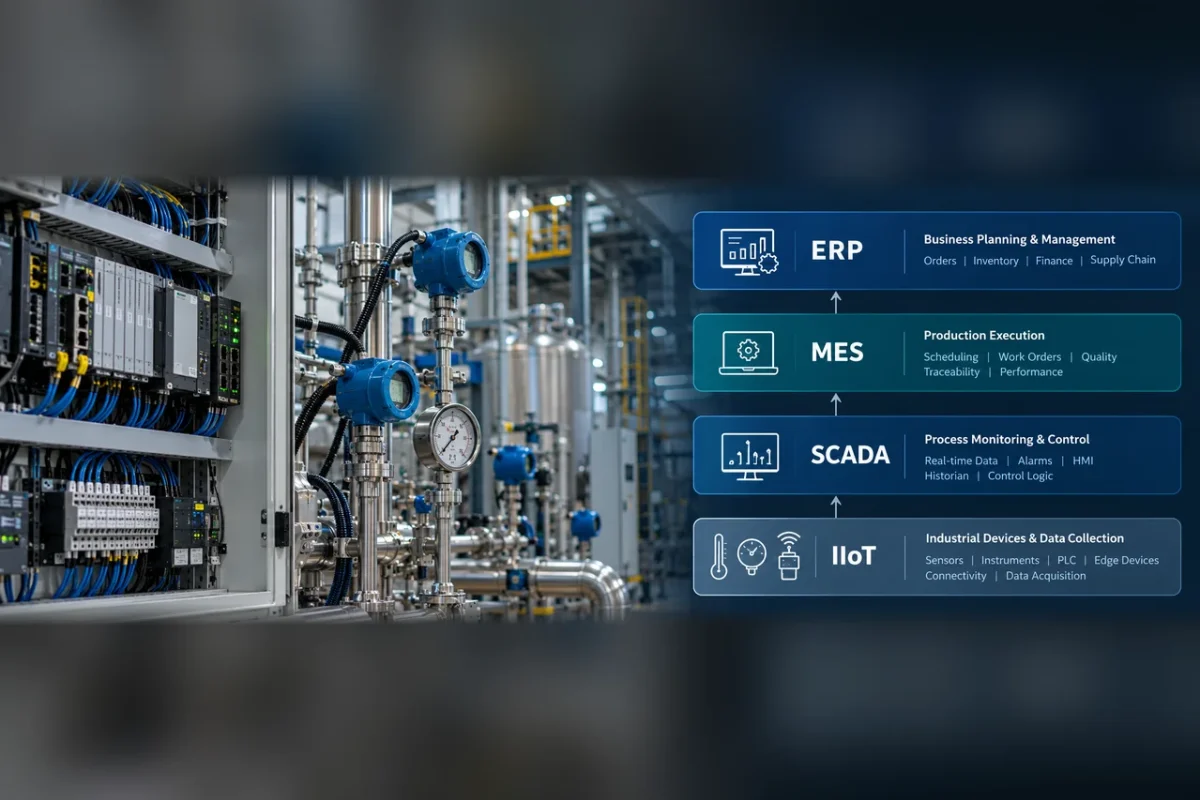
A simple way to understand the stack is to follow the movement of information from machines to business systems.
ERP
Business Planning & Management
↑
MES
Production Planning & Execution
↑
SCADA
Machine Monitoring & Supervision
↑
IIoT
Sensors, Machines & Data Collection
↑
Shop Floor Equipment
This diagram shows the general relationship between the four layers. The exact architecture can vary from one factory to another, depending on its equipment, processes, data requirements and existing software.
The key point is that each layer has a different purpose. IIoT connects equipment and collects data, SCADA provides supervisory visibility, MES manages production execution, and ERP supports wider business planning.
How does IIoT fit into the software stack?
The Industrial Internet of Things, or IIoT, connects machines, sensors, controllers and other industrial devices so that operational data can be collected and shared. It forms an important link between physical equipment and higher-level software systems.
For example, sensors can capture machine conditions, production parameters, energy consumption or equipment status. This information can then be transferred to software platforms for monitoring, analysis and decision-making.
Industrial IoT solutions can be useful when manufacturers want better visibility into machines and processes while continuing to work with existing equipment. The data collected at this layer can also support higher-level systems further up the stack.
What does SCADA do?
SCADA, or Supervisory Control and Data Acquisition, is primarily utilized for real-time monitoring and supervision of industrial processes and equipment.
Operators can use SCADA interfaces to view machine status, process values, alarms and other operating information. This gives production teams a central view of what is happening across connected equipment.
SCADA is therefore different from MES and ERP. Its main focus is shop-floor monitoring and supervision, not production planning or business management.
Where does MES come in?
MES, or Manufacturing Execution System, sits between shop-floor operations and business-level systems. It helps manage and track production activities such as work orders, production progress, quality checks, material usage and traceability.
While SCADA displays the current status of a machine, MES provides additional production context to that data. It can help teams understand what is being produced, which order is running, how much has been completed and whether production requirements are being met.
This makes MES an important part of manufacturing automation software when manufacturers need greater control over production execution, tracking and traceability.
What role does ERP play?
ERP, or Enterprise Resource Planning, operates at the business level. It can manage functions such as purchasing, inventory, sales orders, finance, resource planning and other enterprise activities.
ERP generally works with longer planning cycles than SCADA. It uses business and operational information to support decisions related to materials, orders, resources and costs.
The ERP system does not normally need to control an individual machine. Instead, it can exchange relevant information with production systems so that business planning and manufacturing activities remain aligned.
How do IIoT, SCADA, MES and ERP work together?
The real value of the stack comes from the movement of useful information between its different layers.
| Layer | Main Role | Typical Information |
| IIoT | Connects equipment and collects data | Sensor values, machine conditions, energy data |
| SCADA | Monitors and supervises processes | Machine status, alarms, process values |
| MES | Manages production execution | Work orders, production quantity, quality, traceability |
| ERP | Manages business planning | Orders, inventory, procurement, costs |
Consider a simple production example. A machine generates data through connected sensors, while IIoT technology collects that information. SCADA can then display machine conditions to operators, while MES uses relevant data for production tracking and traceability.
Selected information can also move between MES and ERP. This can help connect production activities with business requirements such as orders, inventory and planning.
Why is integration important for industry 4.0?
Installing individual software systems does not automatically create a connected factory. Each system needs to exchange the right information with other systems while maintaining clear responsibilities for data and processes.
Poor integration can leave operators with one set of information while production planners and management work with another. A connected architecture can help reduce these gaps and give different teams access to information that is relevant to their responsibilities.
This is why industry 4.0 software should be planned as part of a wider manufacturing architecture instead of being treated as a single application.
What are the benefits of a connected software stack?
When the different layers work together, manufacturers can build a clearer view of their operations. Depending on the application, this can provide support:
- Better visibility into machine and production performance
- Faster access to production information
- Improved production and material traceability
- Better coordination between shopfloor and business teams
- More informed maintenance and operational decisions
- Reduced dependence on manual data collection
- Easier identification of production issues and bottlenecks
The actual benefits depend on the factory’s existing equipment, processes, data quality and level of integration.
How should manufacturers build their industry 4.0 stack?
There is no need to implement every technology at once. A practical approach starts by identifying the biggest operational gaps and then selecting the systems that address those specific requirements.
Manufacturers should first understand what data is already available from machines and where information is being lost or manually transferred. They can then assess whether IIoT connectivity, SCADA upgrades, MES integration or ERP connectivity should be prioritised.
Existing equipment should also be considered. Industrial automation software can help connect current machines and systems, allowing manufacturers to improve visibility without replacing an entire production setup.
Scalability is equally important. A solution that works for one production line should have a clear path for expansion to additional machines, lines or plants.
Building a connected manufacturing environment
IIoT, SCADA, MES and ERP are not competing systems. They operate at different levels and address different operational and business requirements. When these layers are connected, manufacturers can create a clearer flow of information from machines to production teams and business decisionmakers.
At DD automation, we combine industrial automation, IIoT and software capabilities to help manufacturers connect machines, processes and operational data. Our industrial IoT solutions, manufacturing automation software and industry 4.0 software approach is built around practical manufacturing requirements and scalable automation needs.
If you are planning to connect your shop floor with production and enterprise systems, speak with our team to identify the right automation and integration approach for your facility.