
The modern workplace depends on interconnected systems to perform daily tasks. This includes everything from office PCs to cloud software, warehouse scanners, production-line machines, and security cameras. These systems exchange data across the network and require reliable connectivity, low latency, and minimal downtime.
Enterprise networking solutions play an important role. They help businesses connect users, devices, applications, and locations through a structured and secure network. For manufacturing and industrial businesses, the network must also support machines, sensors, controllers, and automation systems.
A well-planned network improves connectivity, supports automation, and enables better operational visibility. This guide covers enterprise networking basics, key components, and how to choose the right solution.
What are enterprise networking solutions?
Enterprise networking solutions are technologies, equipment, software, and services used to connect an organisation’s users, devices, systems, and locations.
An enterprise network connects users, devices, applications, and locations across offices, factories, warehouses, branches, data centres, and cloud environments.
Common components include:
- Routers and switches
- Wired and wireless networks
- Firewalls and security systems
- Fibre-optic and structured cabling
- Network monitoring tools
- WAN connectivity
- Industrial Ethernet networks
- Remote access systems
The main goal is to enable reliable communication across the business.
Why do businesses need enterprise networking solutions?
As businesses grow, connected systems such as ERP, cloud apps, warehouse systems, CCTV, IoT devices, scanners, and automation increase. If the network can’t support them, it risks slow communication, downtime, and poor visibility.
A strong network can help businesses achieve:
| Requirement | Networking Benefit |
| Reliable connectivity | Keeps systems and users connected |
| Operational visibility | Allows data to move between systems |
| Scalability | Supports additional devices and locations |
| Security | Helps control network access |
| Automation | Connects machines and control systems |
| Business continuity | Reduces the impact of network failures |
For operations and supply chain teams, reliable connectivity can directly support smoother day-to-day processes.
How do enterprise networks work?
An enterprise network uses different devices and connections to move data between users, machines, applications, and locations.
A handheld warehouse scanner can send inventory data over a wireless network to network infrastructure, which forwards the traffic to the relevant application or cloud service.
A simplified network can be understood as:
Devices → Switches → Routers → WAN/Internet → Applications or Cloud
Different network components perform specific functions: switches connect devices within a local network, routers forward traffic between different networks, and firewalls control traffic according to defined security policies.
Together, these components form the foundation of reliable network infrastructure solutions.
What are the main components of an enterprise network?
An enterprise network includes several components that work together.
- Switches
A switch connects devices within the same network. They connect computers, servers, cameras, access points, scanners and industrial machinery.
- Routers
Routers connect separate networks. They commonly connect offices, plants, warehouses, branches, data centres, and cloud environments.
- Firewalls
Firewalls inspect and control network traffic according to defined security policies. They can prevent unauthorised access and implement network segmentation.
- Wireless Networks
Wireless connectivity supports laptops, mobile devices, scanners, IoT devices, and more. When designing a wireless network, consider coverage, capacity, interference, and security.
- Cabling And Fibre
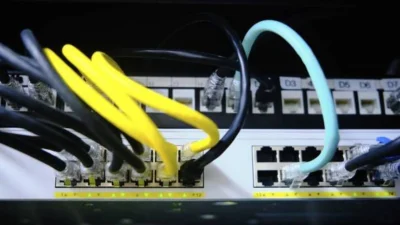
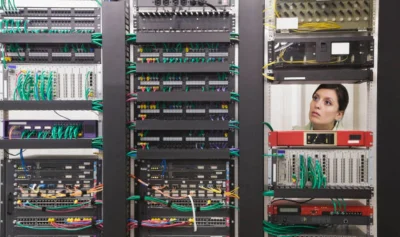
Copper and fibre connections provide the physical foundation of a network. The choice between copper and fibre depends on distance, required bandwidth, environmental conditions, network architecture, and application requirements.
Together, these elements create the physical and logical structure of network infrastructure solutions.
What is the difference between enterprise and industrial networking?
Enterprise networks connect users, applications, servers, and systems, while industrial networks also link machines, controllers, sensors, and automation systems.
The key differences can be seen below:
| Factor | Enterprise Networking | Industrial Networking |
| Primary Focus | Connecting users, applications, and business systems | Connecting machines, controllers, sensors, and automation systems |
| Common Devices | Computers, servers, printers, access points | PLCs, HMIs, sensors, drives, machines, industrial cameras |
| Environment | Offices, data centres, and commercial spaces | Factories, plants, warehouses, and production areas |
| Availability | Important for business applications | Often critical for continuous operations and production |
| Network Requirements | Security, scalability, speed, and user connectivity | Reliability, low latency, redundancy, and operational continuity |
| Environmental Factors | Usually controlled environments | May involve heat, dust, vibration, moisture, or electromagnetic interference |
| Main Objective | Reliable business communication and data access | Reliable machine-to-machine and machine-to-system communication |
This makes industrial networking solutions especially important for manufacturing plants, process industries, warehouses, and other operational environments.
The two networks can collaborate, linking industrial systems and enterprise IT to share operational data with business apps, ensuring segmentation and security.
What are industrial ethernet solutions?
Industrial Ethernet solutions use Ethernet-based technologies to connect industrial equipment and automation systems.
They can support communication between machines, controllers, sensors, production systems, and higher-level business applications.
A reliable industrial network should consider:
- Network redundancy
- Low latency
- Industrial protocols
- Environmental conditions
- Network segmentation
- Industrial cybersecurity
- Equipment compatibility
- Monitoring and fault detection
Industrial Ethernet is therefore more than simply connecting a machine to a network. The network design must match the requirements of the operational environment.
How do industrial networking solutions support smart factories?
Smart manufacturing depends on continuous data exchange.
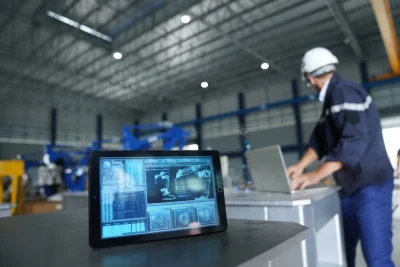
A modern production facility may have sensors collecting data, PLCs controlling machines, HMIs displaying information, cameras monitoring processes, and software analysing production performance.
All these systems depend on reliable connectivity.
Industrial networking solutions provide the communication layer that allows these devices to exchange information. They can also help connect operational technology with enterprise systems.
For example, production data can be shared with business applications, while warehouse equipment can communicate with inventory systems. This creates better visibility between physical operations and digital systems.
How do network infrastructure solutions support supply chains?
Supply chain operations rely on accurate, timely info. Warehouses and distribution centres use scanners, wireless terminals, cameras, automated equipment, and inventory apps.
Reliable network infrastructure solutions help these systems communicate effectively.
They can support:
- Inventory tracking
- Barcode scanning
- Warehouse automation
- Order processing
- Shipment management
- CCTV connectivity
- Asset monitoring
- Multi-location communication
For supply chain managers, dependable connectivity can reduce gaps between physical operations and digital information.
What should businesses consider before choosing a network solution?
The right network should be based on business requirements, not equipment specifications alone.
Businesses should consider:
1. Current requirements: Identify users, devices, applications, locations, and machines that need connectivity.
2. Future growth: Plan for new users, production lines, warehouses, branches, and devices.
3. Reliability: Consider redundancy and backup connectivity for critical operations.
4. Security: Evaluate firewalls, access controls, segmentation, monitoring, and secure remote access.
5. Environment: Industrial sites may require specialized equipment for heat, dust, vibration, and interference.
6. Performance: Assess bandwidth and latency requirements for different applications.
7. Management: Ensure the network can be monitored and upgraded as needed.
A proper assessment can help organisations select enterprise networking solutions that support both present and future requirements.
How can businesses build a reliable network?
A structured approach can reduce implementation risks.
- Assess
Review the existing network, devices, applications, locations, and operational requirements.
- Design
Develop the network architecture, including switching, routing, wireless connectivity, security, segmentation, and redundancy.
- Implement
Install and configure the required equipment while reducing disruption to ongoing operations.
- Test
Check connectivity, performance, security, redundancy, and application communication.
- Monitor
Track network performance and identify faults or capacity issues after deployment.
This approach is especially useful when implementing industrial networking solutions, where network interruptions can affect production or logistics.
Strengthening business connectivity with the right network
A reliable network is now a basic requirement for connected business operations. Enterprise networking solutions support communication between people, applications, devices, and locations, while industrial Ethernet solutions connect machines and automation systems.
At Digital Data Automation Pvt Ltd, we help businesses build reliable connectivity with enterprise networking solutions, industrial networking solutions, and network infrastructure solutions tailored to their operational requirements.
If your business is planning a new network, upgrading existing infrastructure, or connecting industrial and enterprise systems, contact us today to discuss your networking requirements and find the right solution for your operations.